Are the Male Athletes of Sarah Lawrence Happy? (2024)
I have always wondered if Sarah Lawrence Male Athletes are happy. It’s none of my business at all. I obviously am not one myself, nor do I have any in my immediate circle. But the question still remains. Thus, I decided to make an attempt to unveil some answers. I interviewed as large of a group of male athletes that were willing to talk to me, despite me being a stranger. In addition, to honour the integrity of having a large sample size, I interviewed male non-athletes, female athletes, female non-athletes, and given that this is Sarah Lawrence we are talking about after all, neither female nor male individuals of all, um, shapes and sizes.
Before interrogating my sample of Sarah Lawrence male athletes, I asked a couple students about their perceptions of these men, just to get an impression of what the general public thinks. I got responses ranging from “Sarah Lawrence male athletes are to be avoided,” and “I think they’re great and I am friends with a lot of them.” However, there did seem to be a common belief that they are kind of on the fringes here, as the school is mostly female and there’s a pressure to be “alternative.” On a more serious note, some people I interviewed mentioned that they’ve either personally experienced or know someone who has had negative experiences with male athletes at this school, namely incidents involving sexual assault and their treatment of women as a whole. One interviewee did mention that that has little with them being athletes, and maybe has more to do with them being men. If anything, I’ve heard things way worse about the actions of bookish men with septum piercings and dyed hair.
When I asked my sample of non-Sarah-Lawrence-Male-Athletes whether they think Sarah Lawrence Male Athletes are happy, the answers were pretty similar as well. “Lowkey maybe. Because they’re like, you know, living that simple life. They get to play their game, they usually have their shawty, and they just live”— This is a quote from one interviewee that I thought summed up the general response quite effectively.
Another step I took before interviewing my primary sources was conducting archival research. I went through everything the Sarah Lawrence Archives had to offer on Athletics – flyers, rosters, newspaper clippings, and photographs. So what exactly is the history of sports at Sarah Lawrence?
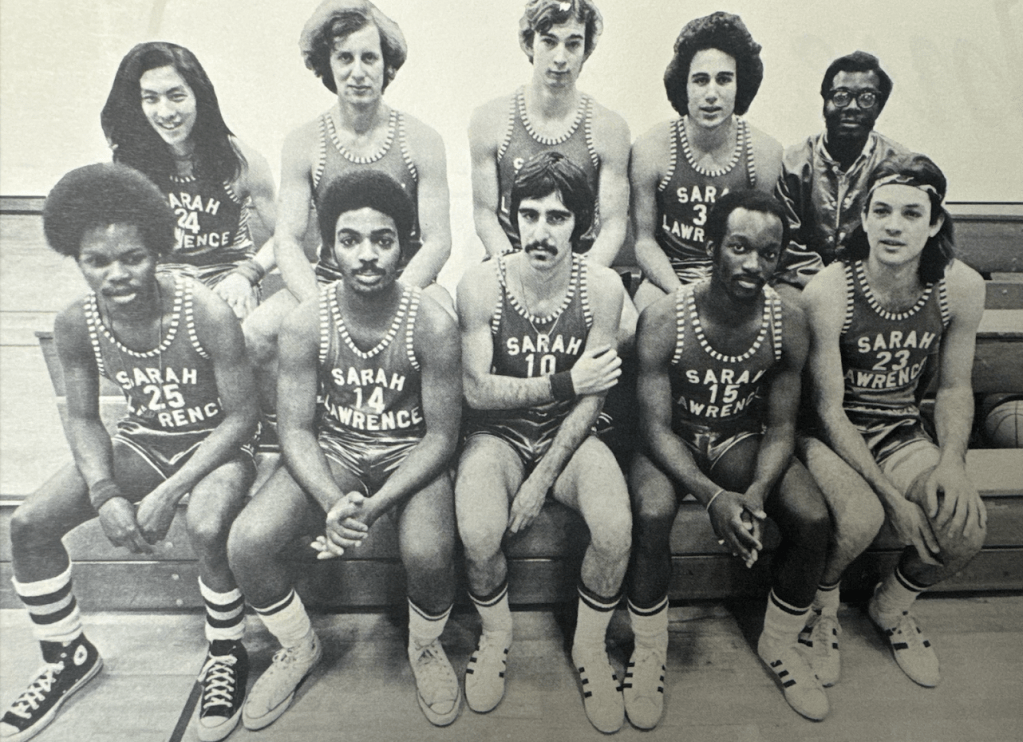
Sarah Lawrence started up their first athletic team the year the school went co-ed, in 1969. Before we had Campbell, the “gym” was in Bates, which was only a humble room with a few dumbbells that was primarily used for yoga and tai chi classes. A couple students gathered there to play 3v3 basketball games, and soon after the Sarah Lawrence Men’s Basketball team was born. It consisted of a 26 year old Vietnam Vet, a sculptor, a modern dance major, and a couple other male students who had no prior experience with basketball. The team was made up of mostly black students, and the team was coached by two middle aged women – Marguerite Shaw and Patty Smyth. Shaw and Smyth lived nearby on Highland Circle, and laundered all of the boys’ uniforms in their home. I couldn’t find anything about their relationship status, but they did share a house and I think “roommate” in any historical piece of anything has become euphemistic to “homosexual.” In a newspaper interview, they describe themselves as “wet nurses”, providing towels and band-aids to the team. Shaw and Smyth also kept the team supplied with beer, cookies, and oranges to enjoy during half-time. The basketball team had several nicknames, including “Green Terror” and “the Wild Bunch.” The Wild Bunch saw a successful debut, crushing both Connecticut College (which had also recently converted to co-ed) and Vassar. I tried to find as many past basketball players to add in a fun Where Are They Now section, but all of their names were pretty common so I couldn’t dig up as much as I could. I found out that one alumnus became a Romanian Politician. Another guy, Uri Berliner, was in charge of NPR for 25 years. When going through all the newspaper clippings, I noticed that a number of the articles mentioned that this new world of Sarah Lawrence Athletics created space for “kids who read Kerouac and Ginsberg, but still have a jump shot.” How has this changed? I feel like it has definitely changed quite a bit. When I look at our athletes today I fail to believe that one of them has read any book at all, Kerouac and Ginsberg aside. No doubt, Sarah Lawrence is still chock-full of post-Beatnik literary posers, only none of them are male– that I know of, anyway. And when they are male, from my observations, their testosterone levels are a tad too low for a jump shot. There’s sometimes enough for an impish leap, when they’re not fried out of their minds. Maybe I am the problem. But I genuinely don’t see any of these guys as the bookish type, and I don’t think I’m wrong. This is where my primary sources come in.
I interviewed a group of male student athletes about their lives at Sarah Lawrence, their hobbies, histories with their sport, and their plans for postgrad.
Steve is a sophomore from Kansas City, Missouri. He is on the men’s basketball team, and he was recruited to play here. His favorite sports team is the Kansas Jayhawks, his favorite player is DeJuan Harris. Outside of basketball, his hobbies include “doomscrolling Instagram Reels” and studying for the MCAT. The first thing I ask him is if he knew about Sarah Lawrence prior to his recruitment.
“I hadn’t heard of it”, Steve says, “I think some people have told me that it came up in some movies like The Notebook or something.”
What is the general consensus about male athletes at Sarah Lawrence? I don’t think about them much as I don’t really know any of them that well, but I did always think it was kind of funny for Sarah Lawrence to have male sports teams. Just seemed a bit funny for a historically women’s liberal arts school that used to have a class dedicated to putting on makeup. Athletes at Sarah Lawrence get bullied. It’s a school full of theatre kids, gay people, gender-nonconforming individuals, emos, one goth that I can think of, and all sorts of freaks. Freaks get bullied by Jocks, as the story always goes. From what I’ve observed, the athletes seem to keep to themselves. They form groups based on teams and schedules, and sign up to live together as well– forming the closest thing Sarah Lawrence will ever see to fraternities. Jocks vs. Preps or Goths or whatever might be a slightly outdated and juvenile phenomenon, but its divisive remnants are still woven tightly into the fabric of American society nonetheless. Evidence of this exists in the fact of the matter: I am reminded of the time there was an slcanonymous scandal a couple years ago, in which athletes and non-athletes (un)alike aired out their grievances about each other in the comment section of a post sent in by someone who felt like athletes got treated badly at this school. There was an overwhelming amount of comments claiming that they were bullied by athletes in high school, and now the dynamics are flipped. Of course they’re gonna bully people who look just like their bullies! While I am not entirely sure if that’s something I stand by, let alone if it’s at all an effective way of processing emotional hurt, but I feel pretty empathetic. I, myself, have experience getting bullied by athlete men: when I was in high school, I got into a pretty heated debate with a 6 ‘9 basketball player about whether or not reverse racism is real. I won’t tell you who argued which side, I will just tell you that the gentleman in question was a blue-eyed, blonde-haired fellow from Long Island and I was a Nonresident Alien from Asia with dyed hair and my nickname was “feminazi.” Has this permanently colored my perception of all men who play sports? No, I love Aaron Judge and have a stolen wheatpaste of him in my bedroom. Has this been one of my few experiences with male athletes and therefore it’s hard to form an opinion about them without having this subconsciously affect my judgment? Yes! But these are Sarah Lawrence male athletes we are talking about. While they all look pretty normal, I know that some of them have tattoos. I’ve even seen a guy on the soccer team with dyed hair.
All of this is to say that it’s interesting to see Jocks at a non-Jock school– are they even Jocks?1 What are their lives even like? Is it reductive to use such a juvenile term to describe a sizable group of young men? I’ve always wondered how their college experience varies from mine— I’m emo, have facial piercings, and I’m a woman, so there are certain aspects of fitting in at this school that I never had to worry about. The school definitely attracts an alternative crowd— I think everyone I know here is female (please pardon the bioessentialist implications of using this term) and has a nose ring. So I do wonder what it’s like for the non-females without nose rings. What do they think about the whole pronouns thing? Do they get weirded out by the furries in their classes the same way I do, or do they get weirded out by them in a different way? Do they like it when they play LCD Soundsystem at the parties? Does that kind of music inspire them to shake their asses the way it does to the majority of the people they go to school with?
Steve feels somewhat like an outcast at a liberal arts D3 school, and acknowledges that “you know, at some, you know, bigger schools, athletes are um…I don’t know how to phrase this…”
“They have clout?” I interject.
“Like yeah. Kind of. Like kind of like that,” Steve says, “but at our school athletics is not a huge thing.”
I asked Steve whether he has experienced any kind of behavior that reflects this attitude, to which he said that he gets some weird looks. “My teammates are like, really big. Yeah like some of my best friends are like 6’9.” This is to say that they are the tallest people on campus, so it’s a little hard for them not to stand out. “Someone on slcanonymous said that we are like– or we look like– dinosaurs, or something like that. Walking around in packs and herds….”
I ask Steve if someone has ever said something mean to his face, something demeaning about him being an athlete at a historically women’s liberal arts school. To this, he told me of a story of a time he was “at like something on the weekend” (I assume this means a party?) and a stranger came up to him and told him that he “has no aura” because he “plays basketball”. How did he react?
“I was like okay, I’m sorry.”
“Yeah that’s weird,” I said.
“I was really confused.”
“Yeah.”
“I was like, I’m sorry, I don’t know what to tell you. Sorry.”
Somewhat awkwardly, I asked Steve how he feels about the gender split at this school– Sarah Lawrence’s 70-30 split is something I have heard of before ever thinking of attending, so I assumed that it was on everyone else’s radar as well. “I don’t think about it too often,” Steve said, “what is it like 70-30 or something?” Steve doesn’t really notice it, as he spends most of his time with his teammates. He lives with 8 of them off-campus, and their schedules force them to be in close proximity as early as 5 in the morning. They spend hours together at practice, during games on the weekend, and they get marginally shorter breaks than the rest of the student body– I guess it makes sense why they travel in “herds”.
Also, Steve is Asian– and Sarah Lawrence is a predominantly white institution. I imagine that it can’t be too easy being a man, an athlete, and on top of it not even white– I ask Steve what his experience has been like as someone who is a triple-minority so to speak (not to imply that being an athlete or a man counts as being a minority, that is literally just how he referred to it).
“It feels pretty familiar to me. I’m from Kansas City, so there’s not too many Asians, or you know, other minorities” Steve responds– “it’s kind of the same for me.”
I told Steve an anecdote from 2 years ago, when someone wanted to put on an all-Asian production of Death of a Salesman but there just wasn’t enough Asian people to fill it. I signed up to do it and the guy organizing it told me that he and I can just have half of the characters, and he can take the other half. It was only us, anyway. Steve’s response was simply “that’s crazy.” I am not entirely sure what to make of his terse response, but I do believe there was a note of empathy and camaraderie in it.
Steve said more on the subject: “Yeah, there’s definitely not a lot of Asians here. Which is kinda weird because you know, we’re in New York. I would expect there’d be a lot of Asian people. Where are you from? Are you from New York?”
“No. I’m from Kazakhstan,” I answer.
“Oh. oh,” he said.
“Everyone’s Asian there,” I said.
“Yeah. Yeah.”
My next question I really dreaded asking– I have this guy I don’t know cornered in a basement with a cardboard cutout of Burt Reynolds in front of me, and the door is locked– the last thing I wanna do is ask about his own personal experience with Golden Dick Syndrome. I do it anyway, for the sake of journalism: “Are you taking advantage of the gender split?”
Steve stumbled around a bit trying to answer this: “Um…I don’t– I don’t even know. I don’t know how to answer that question.” Very succinctly, he told me that he doesn’t see it being a huge success for him. That felt somewhat vulnerable, so I apologized for asking, to which he said “That’s a good question. That’s a good question”. As good of a question as it might’ve been, I didn’t linger and moved onto the next: “what are your plans for after college?”
Steve plans to go into med school, and he is currently in the pre-med track. Although he’s only a sophomore, he spends a lot of time studying for the MCAT– “my plan is to go to med school, because I know that basketball is not gonna last forever.” Steve doesn’t know what type of doctor he wants to be, he will probably figure it out. He’s completely okay with the fact that basketball will not last forever for him– “not my attributes, but like, my physical like.. Standings… and athleticism, probably is not going to, you know, take me to the next level.” Steve has been playing basketball since the 2nd grade, and while he doesn’t see basketball in his future he feels optimistic about closing that chapter and moving on. He wouldn’t mind moving back home, to be closer to his two younger sisters.
Does Steve feel happy and fulfilled as a male athlete at Sarah Lawrence?
“Yeah. yeah, definitely.”
The second male athlete I interviewed is Terry. Terry started playing soccer when he was 2, he played basketball and baseball in 8th grade, but gave those up to focus on soccer as there wasn’t enough time for all 3 and he enjoyed soccer the most. Terry played club soccer throughout middle and high school, and then after he committed to play soccer at Sarah Lawrence he played squash, “just to like, fool around.” Terry actually got recruited from doing club soccer, which I did not know you could do. Terry received a bunch of offers from all sorts of schools, but he didn’t feel like any of them matched both his soccer and academic needs as well as Sarah Lawrence. Terry picked this school because of “the location, the playing time, getting on the field more rather than at other schools.”
Like Steve, Terry’s friends are mostly other athletes – “I would say, in the beginnings, it’s like you’re the only people on campus– I live with them, they’re on the soccer team… waking up at 5:30 and practicing together for 2 months straight– it’s gonna build relationships.” Terry also thinks he is only friends with other athletes because they have a “certain mindset.” What does he mean by certain mindset? “I think you just have to be, like, disciplined– you know you have school but then you’re also, like, waking up at 5:30 AM for 2 months. Resilience is the, like, thing I would take out of all that.” Does he think athletes are more resilient than non-athletes? “I mean like, I’m not saying that. I mean, I don’t know. I feel like– I don’t know.” All of Terry’s friends are athletes, so he doesn’t have the perspective of other students at this school, so he’s not gonna say no one else is resilient. I told him that that’s fair.
I ask Terry what he thinks about athletes getting bullied at this school, to which he says “I don’t think I would say bully is the right term, but, like, there’s a lot of opinions about you at this school because you’re an athlete without people actually knowing who the person is. You’re just grouped in with athletes.” He goes on to say something a bit weird: “And like, obviously, like, things in the past have happened with athletes, like, on this campus… And I think like, based on that, you know, most of the athletes are thrown into that.”
Thrown into what? Is he talking about all of the Title XI cases? Sexual assault? N-word scandals? Bad presentations? Could be any of the above, right?
“Thrown into what?” I ask.
“”I don’t know, like that perception of, like, I would say stereotypes is a good word for it.”
“What is the stereotype?” I prod him a little further. I kind of start feeling bad at this point.
“I don’t know. I don’t know. But I feel like people just think you’re, like, an asshole. Like, you know, the only reason you’re at this school is to play the sport rather than actually, like, wanting to be at this school for other things. Yeah. But that’s not true.”
If that’s not true, what are some other things a male athlete would choose this school for? To Terry, it’s the location, the academics, the ability to build your own schedule, stuff like that.
I move on to my dreaded two-parter question: “What do you think about the gender split at this school?”
“Like, I would say it is a positive part. Like, I don’t think it was a negative.”
“What do you mean by that?”
“I don’t know. I just like, I don’t know. Like, it was, like, it’s one of the main things I heard about this school,” he says, “that’s like, I think, a cool fact.”
Cool how?
“Like, it’s very different compared to other schools I was looking at. Yeah.”
“Have you found that to be a problem?”
“I don’t— I don’t think so,” Terry says, “so there’s not a lot of like, men on campus, right, so kind of like a majority of the males on this campus, like, I don’t know if this is statistically proven, but like, I would say are athletes, because, you know, the soccer team is 35. It’s like big groups.”
I was a bit confused by this. “What’s your point there?
“I’m just saying, like, most of the males I run into are on a team is what I’m saying. I don’t really have any male friends outside of sports, so that could kinda be a downfall of the 80-20 gender split.”
I ask him why it’s a downfall, to which he says “I just think diversity in, like, friendships is pretty important.” In turn, I ask him a follow up question– does he have diversity in his friendships?
“No. Yeah. I mean, no.”
Moving on. I ask him if he takes advantage of the gender split.
“I have a girlfriend who I love, so no.”
“Does she go here?”
“Yeah, she’s on the soccer team.”
I apologize for asking. I ask Terry what he is into outside of sports– I learn that he is in charge of Gryphon Capital, which is a club on campus catered towards students who are pursuing finance postgrad. The club teaches finance, and helps set students up for professional settings–Terry was actually able to get a job through reaching out to alumni who work in finance currently. Terry also has a tattoo of his cat. That’s not something that came up in the interview, I just remember noticing it in class, and when I asked him about it he told me it’s his cat Sammy. Sammy woke Terry’s dad up when he was having a panic attack in his sleep, and was able to save his life. Sammy can also sense when Terry’s about to have seizures– “there was one time I was by the sink and basically collapsed, and [Sammy] was like, by my feet to save me from smashing my head open.”
Is Terry happy?
“Yes. I’m fulfilled with life specifically at Sarah Lawrence at this moment.”
My next interview was with Elliott, who is on the basketball team. Elliott is a junior from New Orleans, Louisiana. Elliott started playing basketball when he was 4-5 years old, in little leagues and casually at school. Elliott’s dad grew up with 3 brothers who he played all sorts of sports with, and Elliott’s mom was a manager for a middle school basketball team– but Elliott says they were not “huge basketball parents.” Elliott gravitated towards basketball as he was having the most success in it compared to other sports– football was the most fun, but he wasn’t as good, same with baseball. Elliott went to a Catholic high school where he played on the varsity team. He’s not Catholic, he’s Episcopalian, he just had to go to a Catholic school because Louisiana has the 2nd worst public education in the country and Catholic schools were better and pretty affordable. For college, Elliott looked at schools far from home – “I was looking to kinda get away from the South a little bit,” he says. “Family was everywhere in New Orleans, and everyone kinda knows everyone [there]. I was just kinda looking to explore somewhere new and kinda get to know new people that didn’t go to my high school.” Elliott ended up getting recruited to play at Sarah Lawrence, and he loves his team. “I feel like we weren’t very good when I first got here, and then we’ve gotten better each year. In terms of the guys, like my teammates, I, you know, have a lot of long lasting friendships.” Most of the people Elliott hangs out with, just like Elliott and Terry, are other athletes.
I ask Elliott the bullying question, to which he says “when I’m walking by myself, I don’t think I’ve ever gotten any bad looks. I mean, I’m 5’10. There are guys on the team who are a foot taller than me and probably stick out a little more.” Elliott says that he knew about the bad rep athletes when he first came here from the guys who were already on the team.
“I feel like we’ve tried to kinda dwindle it out. I feel like a lot of the people they’ve brought in since to be on the team have been better.”
In my head, and maybe I’m awful for this, I’m thinking; what does he mean by better? Less rapists shooting hoops? More 3-pointers, less title 9s?
“What do you mean by guys before? What did they say?” I ask.
“I don’t know specifics. I just know that, kind of, when I came in, I was talking with, like, other freshmen in athletics, and they said that, you know, they had heard stories about like, oh, like, basketball guys, like, just, doing whatever. I don’t know the specifics of the stories, but there was this kind of bad rep around us.”
While I am inclined to think the worst about what “basketball guys, like, just, doing whatever” means, I recognize that I’m biased so I withhold asking any further questions. Elliott believes it’s gotten better, since there’s been such a huge turnover in team members– I’ll choose to believe that too.
In terms of anyone saying anything exclusionary to his face, Elliott tells me that he’s seen it more with professors than students.2 “I’ve had teachers like, you know, make comments about– I’m an economics major3, and I’ve heard the term ‘Wall Street Jocks’ said by a teacher.” This is a term that implies athletes in the class are just “jocks” who wanted to “go make a bunch of money” and “screw everyone over”.
“Compared to the pure and clean profession of economics, we are the dirty ones, like the bankers who were stealing people’s money and things like that. That’s something I’ve heard. We will be responsible for like, financial crises, that like, hurt people’s bank accounts.”
“Is that the plan after graduation” I ask.
“No. definitely not. I actually am looking to go into finance with this economics degree4, but I’m not by any mean looking to screw people over financially at all.”
Dread two parter question. Gender split. Golden dick syndrome.
“Honestly, it’s kind of a nonfactor for me. I don’t have any comments on it.”
Violent follow up: do you take advantage of the gender split?
“That’s a great question. No. I would not say I am taking advantage– I have a girlfriend from New Orleans who I’ve stayed with kinda throughout college. So not in a sexual manner taking advantage, no.”
What does Elliott do outside of sports, if not causing financial crises and taking advantage of women? “I really love listening to music, going to concerts, any type of live music events,” Elliott says – “I am huge in country music. My girlfriend from the south kind of got me into it, and my buddies and I are gonna go to this house concert so I’ll listen to house, I’ll listen to hip hop, and my dad’s really big in like, old jazz. I’ll kinda go listen to whatever.”
Final question, is Elliott happy and fulfilled as a male athlete at Sarah Lawrence?
“Yeah. Yeah. I didn’t really have any expectations coming in, and I feel like it’s worked out really well. Academically, socially, and athletically, I feel like it’s been a huge success.”
The last Sarah Lawrence Male Athlete that I interviewed is Noah. Noah is a Junior on the Cross Country team. Perhaps he is not exactly what I had in mind for my project, as he only became a college athlete this semester, and his reasons for doing so have less to do with his identity at large and more to do with what he finds fun. Noah did not play sports in high school. Noah did ballet for a year in 5th grade, but that does not count. I thought it was important to include a male athlete that is more reminiscent of the first male athletes at Sarah Lawrence– and Noah fit the bill. He’s coming from a dance background, just like the co-captain of the first ever male basketball team at Sarah Lawrence, and he definitely reads Kerouac and Ginsberg, for what it’s worth.
This year is Noah’s first year on the team. He was interested in running cross-country in high school, but he moved around a lot and once the opportunity arose COVID happened and he couldn’t run on Zoom. Last year, Noah and his friends started a run club they dubbed “internal endorphins” – one of his friends is the captain of the Cross Country team, and Noah felt like “the next step in this running journey [I] already started was to join the cross country team.” Noah loves the Cross country team – “our coach, coach Tom, he’s like a blessing of a human being. Like, being a student athlete means a lot just because of how proud I am of the team that I’m on,” Noah says. Noah thinks his teammates are “so cool. When you see them running down the line, it’s like you think it’s super super awesome. It’s really cool to have that familiar relationship with a bunch more people and also like, cheering them on.” I have to mention that the cross country team at Sarah Lawrence is co-ed. I ask Noah how he feels about this.
“I think it’s the best thing to happen since sliced bread. I think it’s, like, super cool to just run with everybody.”
I ask Noah if he thinks of himself as a Jock.
“I don’t even know what that word means.”
I ask Noah his thoughts about other Sarah Lawrence male athletes who are not on a co-ed team.
“I think they’re great. I live with a couple of guys on the soccer team, and the basketball team came to our last cross country meet. And you know, we had like, sandwiches. It was great.”
When I ask Noah his thoughts about male athletes getting ostracized from the community, he says it’s a complex feeling that he empathizes with, but he does not feel like he experiences it personally. He thinks “we should all show a little more kindness to one another”.
Outside of sports, Noah loves to read. He uses this opportunity to go on a tangent about “Jerry Cobb”, who he says is “the woman that killed JFK”. “I can tell you more about that, but that’s just a prelude to my hobby.” Noah also likes to write, and he says that there’s a thousand things that make him, him.
Is Noah happy? “Yes, I would say that I am happy. I am actually on the television screen in the gym, so you just keep an eye out for me.”
From my interviews, I learned that maybe I am the problem. In one of the interviews, one of the guys mentioned how people will come up with all these ideas of what the athlete men are like without even knowing them personally. I have to admit, I have been one of those people in the past. I’ve witnessed my friends make fun of their walks, their outfits, and point at them as they walk together. I’ve witnessed people laugh at them, quite a bit, and I will admit that I have partaken in the laughter too. In reality, I knew nothing of these dudes and was living off of the outdated ideas of Jocks Hate Guys– Sports Guy Hates Emo Girl. I make fun of them for being stuck in high school for playing sports, but here I am basing all of my opinions of these guys on one guy from my high school that was mean to me once.
All of the guys seemed to be happy with their academics, had gratitude for their team, realistic views on their sports careers, tangible plans for the future, and girlfriends (or boyfriends, in Noah’s case, and I’m sure not just him alone). The same cannot be said about the crowds of people that represent the majority of the school. The stereotype that I’ve internalized is that male athletes at this school, and maybe outside of it as well, are assholes and stupid. Now that I think about it, I’ve seen plenty of non-athlete men and women at this school be stupid assholes. Actually, some of the worst things I’ve heard of were done by non-athletes. While it’s hard to ignore the very real issues such as Title IX cases, it’s unfair to say that being an athlete is a correlation. The guy that serially cheated on his girlfriend with everyone that could spare him a cigarette on Kimball bench has never woken up for 5 am practice, and neither did the girl that called her roommate a racial slur. Or the guy that called his roommate the same racial slur the year after. I look at myself, and I think about how I thought about male athletes here as freaks, as if people don’t call me “bone girl” behind my back because they’ve heard about my collection of bones that I keep in front of my collection of human hair. That’s a joke. I took the hair wall down, it’s just the bones now. They’re not even bones, they’re antlers. And there’s only 3. Anyways. All of this is to say that maybe I shouldn’t be calling people freaks when I’m the one writing 17 pages about their lives while they go home to celebrate Christmas with their girlfriends and families. Who’s really the freak? No one is the freak. That’s the point.
Male sports at Sarah Lawrence brings up an interesting discussion of what it means to let men into female spaces, what it means to let something traditional enter a space that has established itself as alternative. It’s only been 54 years since the school went co-ed, so maybe, in the words of one of the male athletes, we should all be a little kinder to one another.
- I know that it was a thing in the 90s and 2000s to adapt Shakespeare plays into movies about American teenagers, and while slightly different, I would love for there to be some kind of equivalent put together about Liberal Arts Colleges nowadays. I feel like we could probably adapt Euripides’ The Bacchae and set it in modern day Sarah Lawrence. Except Dionysus can’t be the god of wine or vegetation, he would have to be the god of the Ugly Mullet Haircut, Fake Lesbianism, and trust funds or something. God(s) knows these people worship these things the same way the women of the mountain worship everything their Dionysus stood for.
Will the mothers of these boys bring their ravaged bodies from Westchester, NY all the way back to their suburban homes after graduation the same way Agave brought back Pentheus’ severed head all the way to Thebes? Judging from what I’ve heard when peer-editing pieces from my Sports Writing class, going home for Winter Break freshman year already feels like bringing their own severed head back to Thebes.
↩︎ - He actually referred to them as teachers, not professors. If I had to analyse that I would say that that’s a sign that male athletes are stuck in high school because that’s when they peaked. But this project is an opportunity for me to open my mind and heart so I won’t say anything. I’ll just leave a snarky footnote. Like a coward. ↩︎
- “Major?” ↩︎
- Isn’t it a Bachelor of Liberal Arts? ↩︎
 dariya.net